
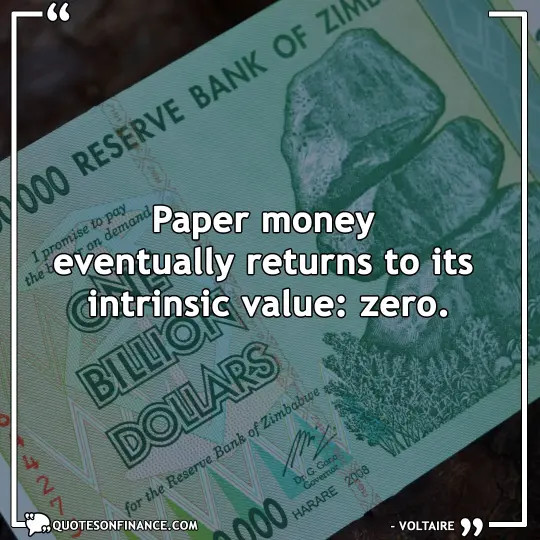
This quote image can by used freely as long as you link back to this page.
Paper money eventually returns to its intrinsic value: zero.
Our take on this quote:
💲 Unmasking the Illusion 💨
Voltaire's timeless warning about fiat currency: When trust runs out, so does its value.
The words resonate with the inevitable truth about paper money and the persistent force of inflation. Over time, the purchasing power erodes, bringing it closer to its intrinsic value: zero. Let us reflect on the fragility of currency and seek avenues to safeguard our wealth against the relentless tides of inflation. 💪🔒
Voltaire’s famous quote is a sharp critique of the dangers of fiat money - currency that isn’t backed by a physical commodity, such as gold or silver. Fiat currencies, like the U.S. dollar or the euro, derive their value solely from government decree and the trust that people place in them. But Voltaire, writing in the 18th century, warned of the inherent risk in this system: without something tangible to back it, paper money can eventually lose all its value.
Fiat currency is based on trust:
Unlike gold or silver, paper money has no intrinsic value. It’s only worth something because people believe it is. This means that if trust in a government or its financial system is shaken, the value of its currency can collapse.
The risk of inflation:
One of the main ways that paper money loses its value is through inflation. When governments print more money to pay off debts or stimulate the economy, the supply of money increases. If too much money is printed without a corresponding increase in goods and services, the currency becomes devalued, leading to inflation or even hyperinflation. Historical examples, like the hyperinflation in Zimbabwe or Weimar Germany, show how rapidly paper money can become worthless when inflation spirals out of control.
History repeats itself:
Voltaire’s warning was based on observations of financial collapses in his own time, such as the disastrous effects of John Law's Mississippi Bubble in France. Law's scheme, which involved issuing large amounts of paper money, eventually resulted in a collapse that wiped out the value of the currency, leaving many people bankrupt. Voltaire's insight that "paper money eventually returns to its intrinsic value: zero" highlights that these problems are not just historical but are still very real today.
Voltaire’s critique is especially pointed because it contrasts paper money with commodity-backed money, like gold or silver. While fiat currency is only valuable as long as people trust the system, commodity-backed currencies have inherent value. Gold, for example, has been used as money for thousands of years precisely because it is scarce, durable, and universally accepted.
Voltaire’s quote underscores that, over time, paper money risks becoming worthless because it lacks that inherent value. When a government or central bank prints too much money, or when people lose confidence in the currency, the value of that paper money can plummet.
In today’s world, many critics of fiat currencies argue that we are seeing similar risks play out. Central banks, especially during economic crises like the 2008 financial crash or the COVID-19 pandemic, have engaged in unprecedented levels of money printing to stimulate their economies. While these measures can prevent immediate economic collapse, they also risk devaluing the currency in the long run.
Cryptocurrency enthusiasts, for instance, often cite Voltaire’s quote to support their argument for decentralized currencies like Bitcoin. Unlike fiat currencies, which are controlled by governments, Bitcoin has a fixed supply and is not subject to inflation in the same way. As concerns about inflation and government debt rise, Voltaire’s warning feels more relevant than ever.
Weimar Germany (1921-1923):
During the period after World War I, the German government printed massive amounts of paper money to pay reparations and fund public spending. This led to hyperinflation, where prices for basic goods like bread soared into the trillions of marks. People were literally carrying wheelbarrows of cash just to buy groceries, and eventually, the German mark became worthless.
Zimbabwe (2000s):
Similarly, Zimbabwe experienced hyperinflation in the 2000s when the government printed vast amounts of money to pay off debts and fund spending. Inflation reached an astronomical level, with prices doubling every day, and the Zimbabwean dollar ultimately became worthless, forcing the country to abandon its currency.
Venezuela (2010s):
Venezuela's economy collapsed due to political mismanagement, economic policies, and excessive printing of money. Hyperinflation led to a situation where the Venezuelan bolivar lost so much value that basic goods became unaffordable, and the currency was essentially worthless on the international market.
Voltaire’s quote continues to serve as a reminder that paper money systems are vulnerable to collapse if mismanaged. The intrinsic value of fiat money - its ability to buy goods and services - rests on the fragile foundation of trust and sound financial policies. When trust in that system erodes, as Voltaire suggests, the currency can return to its intrinsic value of zero.
In the digital age, many are turning to cryptocurrencies like Bitcoin as a hedge against the risks Voltaire warned about. Bitcoin is designed to be a decentralized form of money, free from the control of governments and central banks, with a fixed supply that prevents the type of inflation that can cause fiat currencies to lose their value. For many, it represents a potential solution to the issues that Voltaire highlighted centuries ago.
Voltaire’s quote is as relevant today as it was in the 18th century. It’s a cautionary reminder of the fragility of paper money and the dangers of inflation. In a world where governments continue to print money to solve economic problems, Voltaire’s wisdom still resonates: without trust and proper management, fiat currencies can quickly lose their value, returning to zero, just as he predicted.
Learn more in the free course Bitcoin and crypto explained.
Instagram: quotesonfinance
Facebook: quotesonfinance
X: QuotesOnFinance