Ludwig von Mises - The gold standard

The gold standard

This quote image can by used freely as long as you link back to this page.


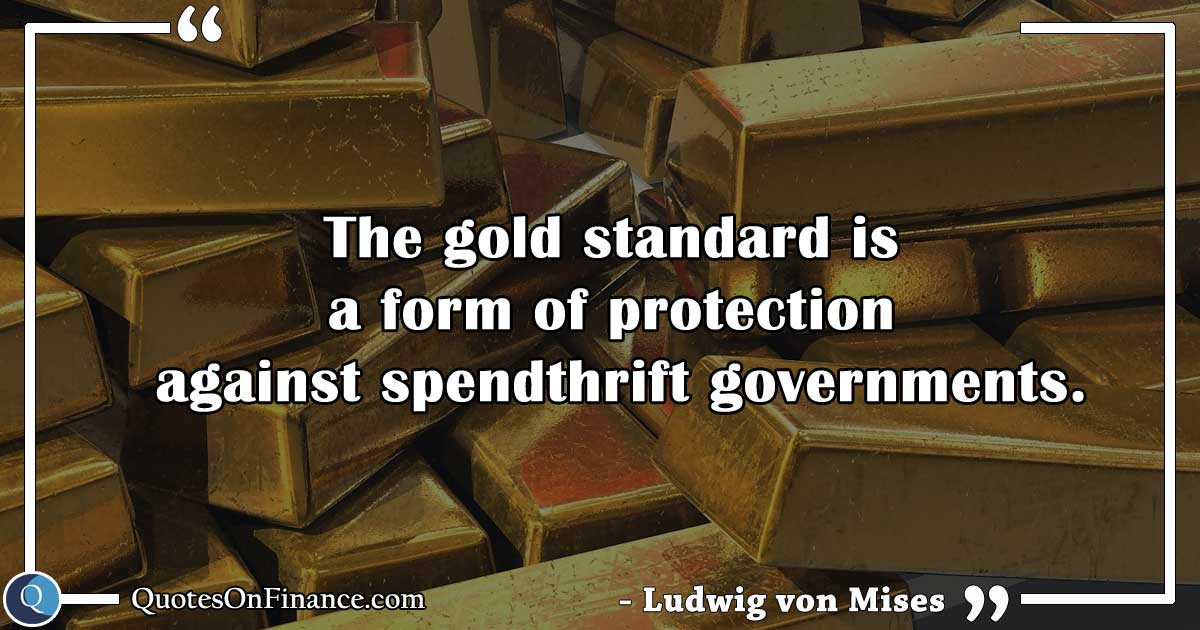
Under a gold standard, sound government has a much better chance; its leaders can say to the people and to the politicians, "We can't do it unless we increase taxes." The gold standard is a form of protection against spendthrift governments.

Our take on this quote:

The gold standard: a safeguard against reckless government spending

Ludwig Von Mises, a leading figure in the Austrian School of Economics, strongly advocated for the gold standard as a way to enforce fiscal discipline and protect citizens from reckless government policies. His statement highlights a fundamental difference between a monetary system backed by gold and one based on fiat currency: under a gold standard, governments cannot print money endlessly to fund their spending.

Instead, they must either increase taxes - which is politically unpopular - or cut spending - which is often resisted by special interests. This natural restraint makes the gold standard a powerful tool against the dangers of deficit spending, inflation, and economic instability.

In this article, we will analyze Mises' statement, explore historical examples, and discuss the implications for investors, politicians, and the general public.

Breaking down the quote

Mises’ quote contains three key ideas:

  1. The gold standard promotes sound government

    • A government operating under a gold standard cannot finance spending by simply printing more money. This forces policymakers to act responsibly and justify their expenditures to the public.
       
  2. Political leaders must face fiscal reality

    • Without the ability to create money out of thin air, politicians must either raise taxes or cut spending to fund new projects. This prevents reckless policies that burden future generations with debt.
       
  3. The gold standard acts as a defense against overspending

    • Fiat currency systems allow governments to devalue money through inflation, effectively imposing a hidden tax on savings and wages. A gold-backed system prevents this by requiring real backing for every unit of currency issued.
       

Real-world examples of fiscal restraint vs. recklessness

1. The Classical Gold Standard (1870–1914): Stability and Prosperity

  • What Happened?

    • During this period, major economies operated under a gold-backed monetary system, leading to low inflation, long-term price stability, and rapid industrial growth.
    • Governments were forced to balance their budgets, as they could not simply print money to cover deficits.
       
  • Lesson learned:

    • The gold standard incentivized responsible governance and economic stability.
       

2. The Abandonment of the Gold Standard (1971): The Rise of Inflation and Debt

  • What Happened?

    • In 1971, U.S. President Richard Nixon ended the convertibility of the U.S. dollar into gold, marking the beginning of the modern fiat currency era.
    • Since then, global debt has skyrocketed, and inflation has become a persistent economic issue.
       
  • Lesson learned:

    • When governments are no longer constrained by a gold standard, they tend to overspend, leading to higher debt and currency devaluation.
       

3. Hyperinflation in Venezuela: The Cost of Printing Money

  • What Happened?

    • The Venezuelan government financed excessive spending by printing money, leading to hyperinflation exceeding 1,000,000% per year.
    • Citizens lost their life savings, and basic goods became unaffordable.
       
  • Lesson learned:

    • Fiat money can be abused by reckless governments, leading to economic disaster. A gold standard would have prevented this.
       

Lessons for investors

  1. Gold is a hedge against fiat currency instability

    • Since fiat money can be devalued through inflation, investors should hold gold and other scarce assets to protect their purchasing power.
       
  2. Debt-fueled growth is unsustainable

    • Investors should be cautious about economies that rely heavily on deficit spending, as this often leads to inflation and financial crises.
       
  3. Diversification is key

    • Allocating part of an investment portfolio to gold, Bitcoin, and other hard assets can provide stability in times of fiat currency devaluation.
       

Implications for politicians

  1. Governments must justify their spending

    • Under a gold standard, policymakers must explain how they will fund new programs - either through higher taxes or spending cuts.
       
  2. Fiat money enables political manipulation

    • Without gold backing, governments can print money to fund wars, social programs, or bailouts, shifting the cost onto future generations through inflation.
       
  3. Economic stability requires fiscal discipline

    • A return to sound money principles, whether through gold or a Bitcoin standard, would reduce financial crises caused by reckless monetary policies.
       

Key takeaways

  1. The gold standard prevents governments from inflating away the value of money.
  2. Without sound money, politicians tend to overspend and shift the burden to citizens through inflation and debt.
  3. Investors should protect themselves by holding gold and other hard assets that cannot be manipulated by governments.
  4. Fiat currency systems create incentives for short-term political gains at the expense of long-term economic stability.
  5. A return to sound money principles would restore fiscal discipline and prevent economic crises.

Final thoughts

Ludwig Von Mises’ insight remains highly relevant today. The shift from gold-backed money to fiat currency has led to excessive government spending, inflation, and unsustainable debt levels worldwide. While a full return to the gold standard may not be politically feasible, the principles of sound money remain crucial for economic stability.

For individuals and investors, the best defense against fiat currency instability is owning real assets like gold and Bitcoin, which cannot be printed at will by governments.

For policymakers, the lesson is clear: without monetary discipline, economic prosperity is at risk. The gold standard may no longer be the global norm, but the need for fiscal responsibility is greater than ever.

Stay connected with us on social media

Instagram: quotesonfinance
Facebook: quotesonfinance
X: QuotesOnFinance