Ron Paul - The Founding Fathers

The Founding Fathers

This quote image can by used freely as long as you link back to this page.


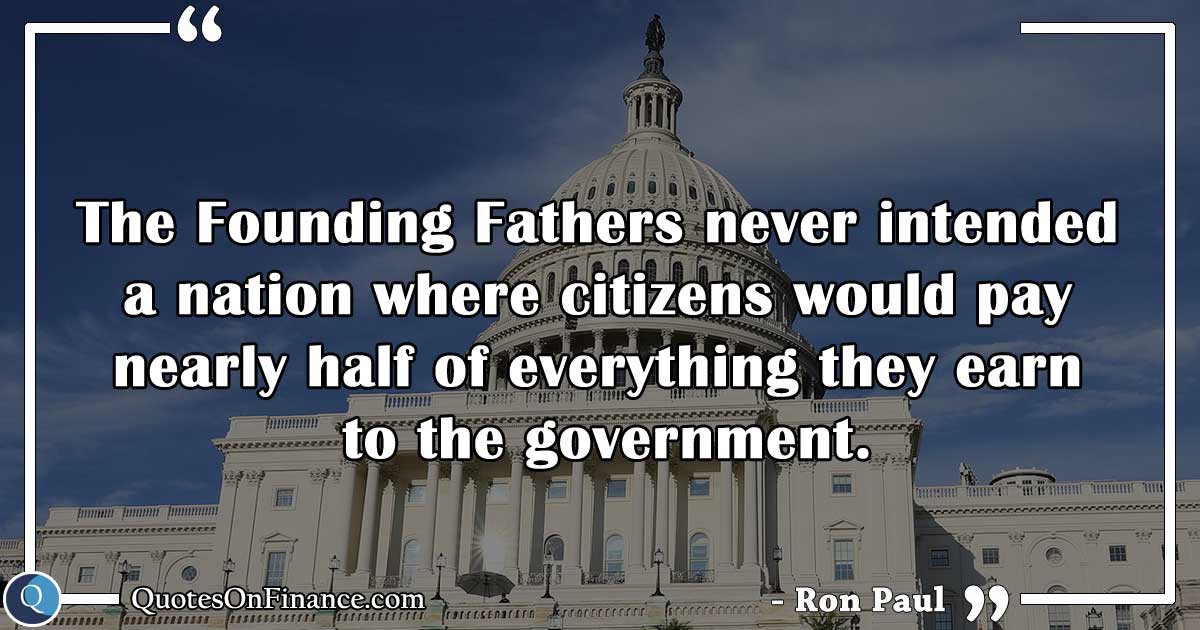
One thing is clear: The Founding Fathers never intended a nation where citizens would pay nearly half of everything they earn to the government.
Our take on this quote:

Breaking down the quote

Ron Paul, a long-time critic of big government and a staunch advocate of individual liberty, captures a powerful truth in this quote: Taxation in modern times has drifted far from the intentions of America's Founding Fathers.

The original U.S. Constitution was built on principles of limited government, individual property rights, and personal freedom. At the time of the American Revolution, colonists rebelled over a tea tax — imagine how they would react today to income taxes, payroll taxes, sales taxes, capital gains taxes, estate taxes, and more.

Ron Paul’s statement highlights the disconnect between America’s founding ideals and today’s political reality, where governments at all levels can claim up to 40–50% of an individual's income through direct and indirect taxation. The quote serves as a reminder to question whether this level of government control aligns with the concept of a free and self-governing people.

Key takeaways

  • Taxation levels have grown exponentially since the founding of the U.S., particularly in the 20th century.

  • The Founders designed a system to limit government power, not fund a sprawling administrative state.

  • Government spending is closely tied to taxation, and as budgets balloon, so too do tax burdens.

  • Citizens must ask: Where is the line between funding essential services and losing economic freedom?

Real World Examples

📜 The U.S. Constitution

The Founding Fathers explicitly rejected direct income taxes. The 16th Amendment (1913), which legalized federal income tax, was never part of their vision.

💰 Today’s Tax Burden

In many Western countries, individuals face effective tax rates nearing 50% when accounting for all levels of taxation, including hidden taxes like inflation, which erodes purchasing power.

🔄 European Welfare States

Many Scandinavian countries operate with high taxes and large governments. While often praised for social benefits, they also face slower economic growth, capital flight, and rising dissatisfaction among younger generations over lack of upward mobility.

Lessons for Investors

  1. Tax drag matters. Capital gains, dividends, and wealth taxes eat into long-term returns. Structure your portfolio to minimize tax exposure.

  2. Inflation is a hidden tax. Central banks devalue currencies through money printing — protecting yourself with hard assets like Bitcoin, gold, or real estate is a hedge.

  3. Geographic diversification. Consider the tax implications of different jurisdictions. Some countries offer investor-friendly regimes and lower tax burdens.

Implications for Politicians

  • Revisit the role of government. Is it to provide essential services, or manage every facet of economic and social life?

  • Streamline taxation. Simplifying tax codes and lowering rates can increase compliance and productivity.

  • Respect constitutional principles. The Founding Fathers’ emphasis on liberty, limited government, and property rights should remain the guiding light for policy decisions.

Implications for Citizens

  • Stay informed. Most people are unaware of their total tax burden.

  • Vote accordingly. Support policies and candidates that prioritize fiscal responsibility and personal freedom.

  • Consider financial independence. The more self-reliant you are, the less dependent you are on government programs — and the more freedom you preserve.

Final Thought

Ron Paul’s quote serves as a wake-up call. It’s not just about taxes — it’s about the kind of society we want to live in. Do we work to support ourselves and our families, or are we slowly becoming employees of the state?

If the Founding Fathers stood against a minor tea tax, what would they say about losing half of your income to taxes today?

It’s time we asked that question — and acted accordingly.

Stay connected with us on social media

Instagram: quotesonfinance
Facebook: quotesonfinance
X: QuotesOnFinance