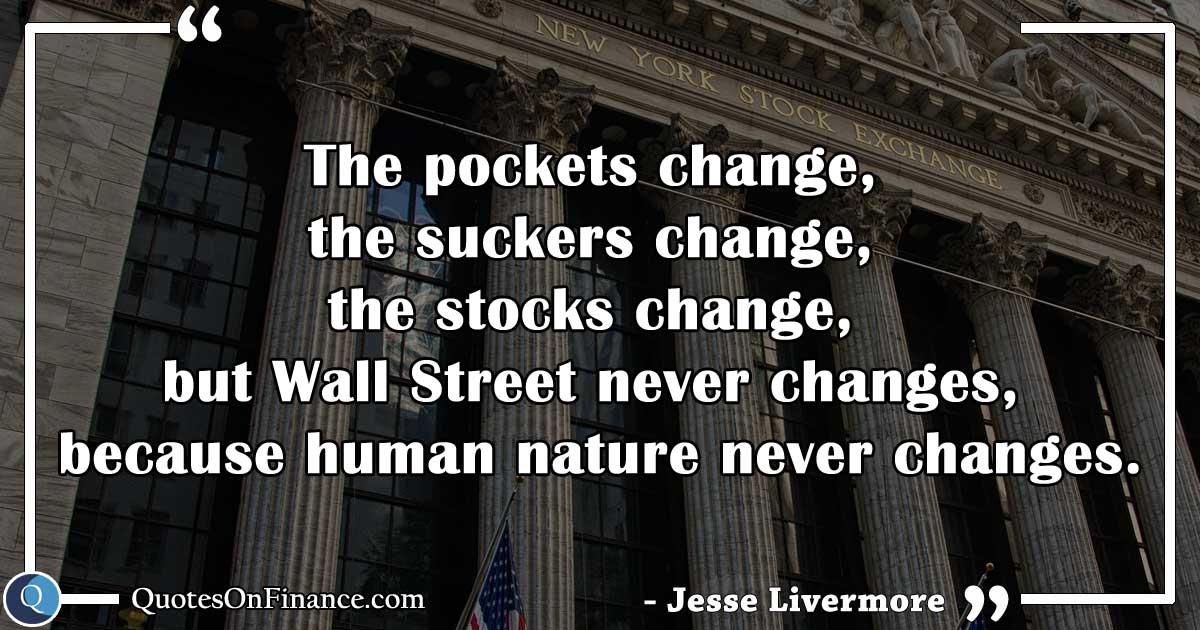
Markets evolve, but the core of human behavior driving them remains constant. Wall Street's cycles are driven by timeless human emotions - fear, greed, and speculation. The names may change, but the patterns remain the same. 🧠💡
Jesse Livermore, one of history's most famous stock traders, offers profound insight into the enduring dynamics of Wall Street. In this quote, he reflects on the unchanging nature of the financial markets, despite the ever-shifting players and assets involved. For Livermore, it’s not the particular stocks or traders that define the market, but the fundamental and timeless aspects of human psychology - fear, greed, and the allure of quick riches. This perspective encourages traders and investors to recognize and understand these enduring patterns in order to navigate the markets more effectively. By staying aware of these unchanging human tendencies, one can make more informed and strategic decisions in the ever-evolving financial landscape.
Breaking down the quote
"The pockets change, the suckers change, the stocks change..."
Livermore begins by acknowledging the constant turnover of individual participants in the market. New investors come in, old ones leave, stocks come and go, and the composition of the market changes over time.
The “pockets” represent the people with money to invest, while the “suckers” represent those who fall prey to market traps, often due to greed or inexperience. Wall Street has always attracted a mix of seasoned professionals and novice investors looking to make a fortune, and this mixture creates opportunities for market volatility.
Stocks themselves evolve, reflecting the changing nature of business and technology. In Livermore’s time, the dominant stocks might have been in industries like railroads, steel, and oil, while today’s markets are dominated by technology giants. Yet, regardless of the specifics, the essential market mechanics remain the same.
"...but Wall Street never changes..."
Livermore asserts that the core of Wall Street is fundamentally static, governed by the same forces regardless of the era or the assets involved. While there may be advancements in trading technology, regulations, or investment products, the underlying nature of the market remains unchanged.
This phrase captures the idea that markets are cyclical, going through periods of boom and bust that follow predictable psychological patterns. Wall Street may look different on the surface over time, but its essential structure and rhythm remain.
"...because human nature never changes."
For Livermore, the reason Wall Street remains the same is due to the constancy of human nature. Human emotions - fear, greed, hope, and desperation - drive market cycles. Investors, regardless of era or expertise, often succumb to these emotions, leading to repeated patterns of speculation and irrational decision-making.
Livermore’s perspective reflects a deep understanding of psychology’s role in trading. Traders are often their own worst enemies, allowing emotions to cloud their judgment and drive impulsive decisions. Even in today’s market, advanced algorithms and data analytics cannot fully eliminate the influence of human psychology.
This statement is also a caution to investors. Recognizing the permanence of human emotions in the market can help traders make better decisions, avoiding the traps of greed during bull markets and fear during bear markets. Livermore’s wisdom underscores the importance of self-discipline and the ability to control one’s emotions to succeed in the market.
Livermore’s ideas in the context of modern markets
Livermore’s insight remains strikingly relevant in today’s era of high-frequency trading, 24-hour news cycles, and globalized financial systems. The basic emotional drivers he describes are just as present now as they were in the early 20th century. While technology has advanced, making trades faster and information more accessible, human nature still rules the market.
The influence of fear and greed
These emotions remain central to market dynamics. During a bull market, investors often become overly optimistic, driving up prices beyond reasonable valuations. In bear markets, fear takes over, leading to panic selling and sharp declines. The financial crisis of 2008 and the stock surges of 2020-2021 illustrate these emotional cycles well.
Despite having more tools, data, and advice available today, individual and institutional investors alike still make decisions influenced by these emotions, leading to boom and bust cycles.
Market cycles and behavioral patterns
Livermore’s understanding of cyclical market patterns continues to hold true. Even though financial instruments and regulations have evolved, the core principles of market cycles remain consistent.
For example, bubbles continue to form in sectors with high speculation (such as the dot-com bubble or the cryptocurrency bubble), and crashes still follow when reality clashes with inflated expectations. Understanding that these cycles are natural and often emotional can help traders anticipate market movements.
The rise of behavioral finance
Livermore’s focus on human nature has become a foundational concept in behavioral finance, which examines the psychological influences on investors’ financial decisions. Academics like Daniel Kahneman and Richard Thaler have developed theories on irrationality and cognitive biases that align with Livermore’s observations.
Concepts such as “herd mentality,” “confirmation bias,” and “loss aversion” all illustrate how emotions and cognitive biases can lead to poor investment decisions. Livermore’s observation that human nature never changes supports the idea that these biases will continue to influence markets indefinitely.
The wisdom of a disciplined mindset
Livermore’s insight serves as a reminder to approach the market with caution, self-awareness, and discipline. Successful investing requires resisting emotional impulses and recognizing that while stocks and people change, the emotional triggers that lead to poor decision-making remain the same.
By developing a disciplined strategy, investors can navigate the highs and lows of the market without getting caught in the extremes of fear or greed. Livermore’s advice is as relevant to modern day traders as it was in his time, underscoring the importance of staying grounded in the face of market hysteria.
Key takeaways
Human emotions drive markets
Wall Street’s cycles are driven by psychological factors that are timeless. Despite technological advancements, human nature remains the same, and emotions like fear and greed continue to dictate market movements.
Market patterns are predictable and cyclical
The stock market may evolve, but its core behavior remains consistent because of recurring emotional patterns. By studying historical cycles, traders can better prepare for future market phases.
Investing requires discipline and self-awareness
Recognizing the unchanging influence of human nature on markets, investors should prioritize discipline and emotional control in their trading strategies. Understanding and mitigating one’s own psychological tendencies is key to avoiding the traps Livermore describes.
Modern relevance of Livermore’s insight
Behavioral finance and modern market psychology confirm Livermore’s observation that Wall Street is largely driven by human emotions. Even with algorithms and data-driven approaches, the fundamental nature of the market remains tied to emotional cycles.
Jesse Livermore’s quote offers a timeless lesson for investors. The financial markets will always attract new players, new assets, and new opportunities, but the underlying psychology remains unchanged. Wall Street is built on a foundation of human emotions, and the patterns that govern markets are deeply rooted in these emotions. While technology, regulations, and global connectivity have changed the way we trade, the core drivers of market behavior are as old as time itself.
Livermore’s wisdom encourages investors to respect the emotional undercurrents of the market and approach it with a disciplined, self-aware mindset. His insight reinforces the importance of understanding not only the technical aspects of investing but also the psychological factors that shape financial decisions. By acknowledging and managing the influence of human nature, traders can navigate Wall Street’s eternal cycles with greater resilience and success.